

The Data Foundation That Makes Your AI Possible

We’ve spent years helping organisations automate their processes, orchestrate AI agents, and eliminate manual work across operations. But in every engagement, we kept running into the same wall: the automation was fast, the AI was capable — and the data underneath it all was holding everything back.
Silos. Late reports. Every department with its own version of the numbers. IT queues that turned a simple dashboard request into a weeks-long wait. Sound familiar?
This is not a people problem. It is an infrastructure problem. And it now has a clear solution.
Why Microsoft Fabric changes everything
Microsoft Fabric is the first platform we’ve seen that genuinely unifies the entire analytics stack — data engineering, warehousing, real-time intelligence, and Power BI — in a single environment, built on a shared storage layer called OneLake. One source of truth. No duplication. No tool sprawl.
What makes this moment significant is timing. Just two and a half years after reaching general availability, Microsoft Fabric is already serving more than 31,000 customers and remains the fastest-growing data platform in Microsoft’s history. The platform is not a bet on the future — it is the present standard, and organisations that build on it now will arrive at AI with a structural advantage over those that wait.
The companies that build their data foundation now will reach AI ready. Those that wait will modernise in reactive mode — under pressure, at higher cost, with lower confidence in their data.
Enterprise data platforms will no longer be judged by how much data they store, but by how intelligently they activate it. Fabric is designed exactly for this shift: from fragmented analytics stacks to an AI-powered intelligence layer that unifies data engineering, analytics, governance, and AI at scale.
What we saw in the market — and why we built this unit
Launching ARPA’s Data & Analytics unit was not a pivot. It was the logical completion of what we already do. Our Intelligent Automation Factory orchestrates RPA, AI agents, and intelligent document processing across our clients’ operations. But automation without insight is blind. Every automated process generates data. Every AI model needs governed, quality data to learn from. We were building the engine without the fuel system.
We chose Microsoft Fabric as our platform of choice because it solves the right problem: it doesn’t add another tool to the stack — it replaces the stack. And it does so while being AI-ready by design, with Copilot and Fabric IQ embedded at every layer.
How we deliver: method, team, and accelerators
We don’t believe in long, open-ended implementation projects that take months to show results. Our delivery model is built on three principles: start with a diagnosis, create visible value fast, and expand progressively.

These are not theoretical projections. They are the ROI levers we consistently identify in our Fabric Readiness Assessments — the diagnostic engagement we always begin with, before any implementation work starts.
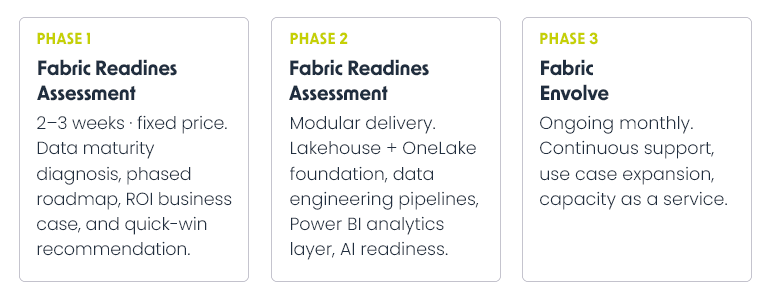
Our certified team — Fabric Architects, Data Engineers, BI Developers, and Data Analysts — brings real enterprise experience. We use our own pre-built accelerators: semantic models, reference architectures, and pipeline templates that significantly reduce time-to-value. And we enter every engagement with a paid Assessment, because we believe a diagnosis should happen before any implementation begins.
The bottom line for leaders
For the CFO and CEO: shorter time-to-decision on critical information, and the elimination of hidden costs from redundant tools, manual consolidation, and slow reporting cycles. For the CDO and CIO: a unified, governed, AI-ready platform — without disrupting the business during the transition. For operational teams: the ability to answer their own data questions, without opening a ticket and waiting.
The question is no longer whether to modernise your data foundation. The question is whether you do it now — with a clear method and visible quick wins — or under pressure later, when the cost of delay is measured in missed decisions.
We start with the Assessment. Two to three weeks. Fixed price. A concrete deliverable that gives your leadership team a roadmap, a business case, and a recommended first step.
